
What perception does — and what it doesn’t
Have you ever been sure that something was broken, and so broken that you couldn’t figure out how to fix it?
Or lost something, only to find it exactly where it was supposed to be?
What’s the lesson in that?
Was it really broken, really lost? Or was it what you believed?
The window
For years I thought one of our living room windows was broken. I’d crank the handle and nothing would happen. So I stopped trying. It was a broken window, and that was that.
Then one day, without thinking, I cranked the handle the other way.
It opened.
Yes, the crank was on backward. But did that ever occur to me? No. I had decided it was broken, and a broken window doesn’t invite you to try again.
The notebook
In our car, I keep a black binder with a small tablet tucked inside. One morning I carried it into a restaurant so Del and I could talk over a few things while I took notes.
Before we drove away, I reached for the notebook. It wasn’t there. I hurried back inside, looked under the table, checked the bathroom, and asked the waitress. Gone. I missed that notebook.
Weeks later, I reached down to the place I always keep it, and there it was.
I hadn’t seen it. I couldn’t. My perception was that I had lost it, and that perception made what was already present invisible to me. Only when I forgot all about it did what was there all along become visible.
The duck
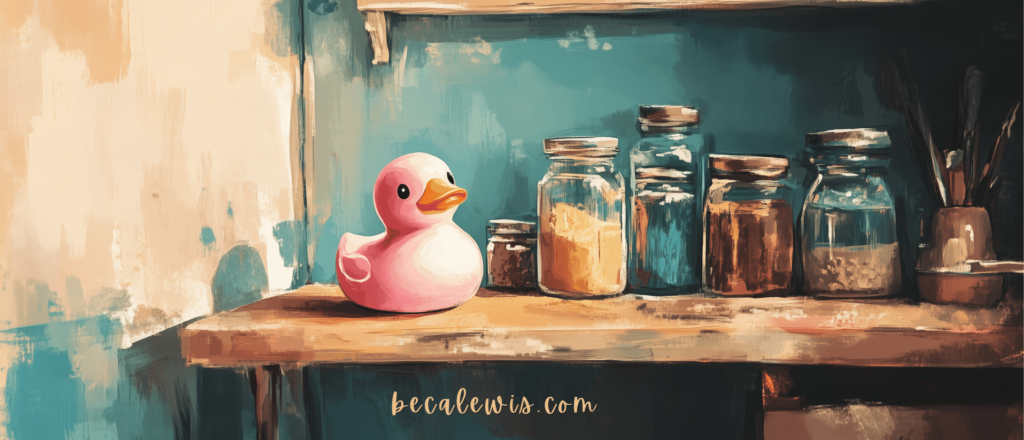
One of our granddaughters has always loved little rubber duckies. She’s a podiatrist now, and she still loves them. Near her birthday, we spotted a cute one at a checkout counter, bought it, and saved it for the next time we’d see her.
In the meantime, Del and I played a game we’ve played before: hide something in fairly plain sight and see how long it takes the other person to find it. The duck was the next victim.
The rules are simple. It has to be somewhere we’d eventually look. It has to be in the living room or kitchen. And it can’t be so high that I can’t see it.
Now, I consider myself very aware of what’s in that space. Ask me where anything is, and I’ll tell you the drawer, the cupboard, the shelf. Besides, we live in a very small house.
But I could not find that duck. I looked everywhere, which means quite a few drawers and cabinets got cleaned out in the process.
Finally, one day, I pulled the spice rack all the way out. There it was. In plain sight.
Once again, my perception that I had already looked everywhere had hidden it from me.
What perception does, and what it doesn’t
Yes, this is all about perception, and about what it does and doesn’t do.
Perception doesn’t create. It doesn’t co-create. It doesn’t manifest. It doesn’t destroy.
It does the bidding of our senses and of what we believe.
We could even say it’s doing us a favor. In our belief in being human, we’re limited in what we can handle.
Everything is already present, as either a wave or a particle in our human way of understanding things, and we are simply not built to take all of that in at once.
So perception filters.
Then we believe what we see. And so it gives us more of it.
Which means that if we want something to change, to be different, to be experienced differently, or if we want to find what we’re looking for, there is one thing to do. Shift our perception of it.
Who’s in charge?
You can choose a better human perception, and when you do, you might use words like co-create or manifest. But honestly, you never did either one. Y
ou shifted your perception, and in doing so you caught a glimpse of the universe in its unending, infinite abundance.
Some people may not like this. After all, don’t we all enjoy, to some measure, being in charge?
But seriously, if you want to be in charge, you have a massive job ahead of you: managing the universe and all its infinite parts.
For me, no thank you. I couldn’t manage to find a notebook or a duck, and it took me years to crank a window in the direction that worked.
Isn’t it enough to be “in charge” of shifting our perception so that what we need, want, or are ready for can be seen? It’s already here.
That’s plenty of work to keep me busy.
Yes, I create. I write. I doodle. I garden. But I am not the Creator, and I don’t co-create or manifest. I shift my perception.
And even though that’s a full-time job, I’ll take it. Because it means I can choose a perception that provides good for everyone, knowing that in some small way, I’m doing exactly that.